Homily – Sunday, the 1st Feb 2026
Readings: 1 Kings 17.8–16 & John 2.1–11
Let’s play a game of ‘memory’ (or ‘concentration’ or ‘match’ or however you may call it), shall we?
You know how it works, right?
We’ve got all those cards in front of us, and need to find matching pairs.
Matching pairs that fit this morning’s bible stories, to be precise.

The first story is from the Old Testament—from the Hebrew scriptures.
It is set in a time of drought and famine.
The prophet Elijah goes to Zeraphath, a foreign territory outside his homeland Israel.
He meets a poor widow who is just about to cook the very last meal for herself and her son, before their food runs out and they’ll starve.
Elijah dares to ask the woman to make him some bread.
And indeed, the woman does as she is asked and the miracle happens:
The flour jar and oil jug never run dry.
All three of them—the child, the mother, and the prophet—can eat until the famine comes to an end.
The second story is from the New Testament.
It is set at a moment of feasting and rejoicing.
Jesus, his friends, neighbours, and family are at a wedding in Cana, a village near their hometown.
Jesus’ mum, Mary, notices that the wine has run out, even though the party is still in full swing.
She nudges Jesus, who dares asking the servants to fill water into huge jugs.
And indeed, the servants do as asked and the miracle happens:
The water turns into delicious wine.
The whole village—including Jesus and his mother—can keep on partying until the cows come home.
Have you already spotted some pairs in these stories?
Some contrasting counterparts?
Let’s see what we can find, ok?
(And let’s hope we do better than I do when I play this game…
I really am hopeless!
I think I’ve never ever won a round of ‘memory’.)
Human Action & Divine Mystery

Let’s have a look at our very first pair,
the most essential of them all.
In both stories we find human agency and God’s presence intertwined.
There is this beautiful interplay and dependency.
Human action and divine mystery interact with each other.
The poor widow and the wedding servants set to work.
They fire the oven.
Grind flour.
Bake bread.
Go to the well.
Carry pots of water.
Fill the big jugs.
And then the unthinkable happens:
God does his part of the work.
God provides and multiplies, and nobody really knows how.
Good old physical work and divine transcendence are closely interwoven.
Both together, they form the backbone of these two stories.
Visionary & Practicioner
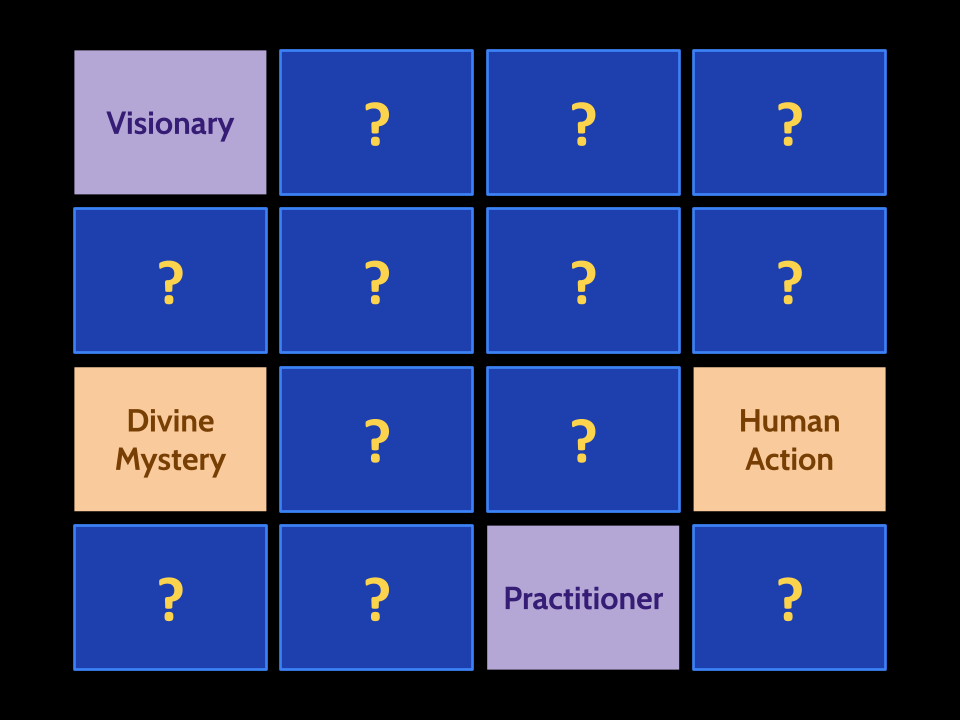
Our next pair leads on from there.
Both times, we’ve got two types of protagonists:
a sort of visionary, and someone putting things into practice.
The who-is-who is easily spotted in the Elijah story:
the prophet has the vision from God,
the woman bakes the bread.
Easy.
It’s a bit trickier with the second story:
The servants put in the physical labour, that’s for sure.
They commit to the task at hand.
But who is the visionary?
Jesus, right?
We can only guess what went through his mind that day …
But what if it was his mum’s nudging that got him on track in the first place?
What if Mary’s foresight and female intuition
ignited the vision of an impending miracle?
Who knows?
What I do know, though, is how I, and maybe you also, tend to often discount or overlook the committed doer in favour of the bold visionary:
in these stories,
in politics,
in media,
families,
supermarkets,
workplaces,
schools,
churches …
Yet both visionaries and doers face their own challenges.
Both have to have trust and focus.
Both are essential for a satisfying outcome.
Visionary initiative and committed practice:
each is admirable,
each is crucial.
Mother & Son
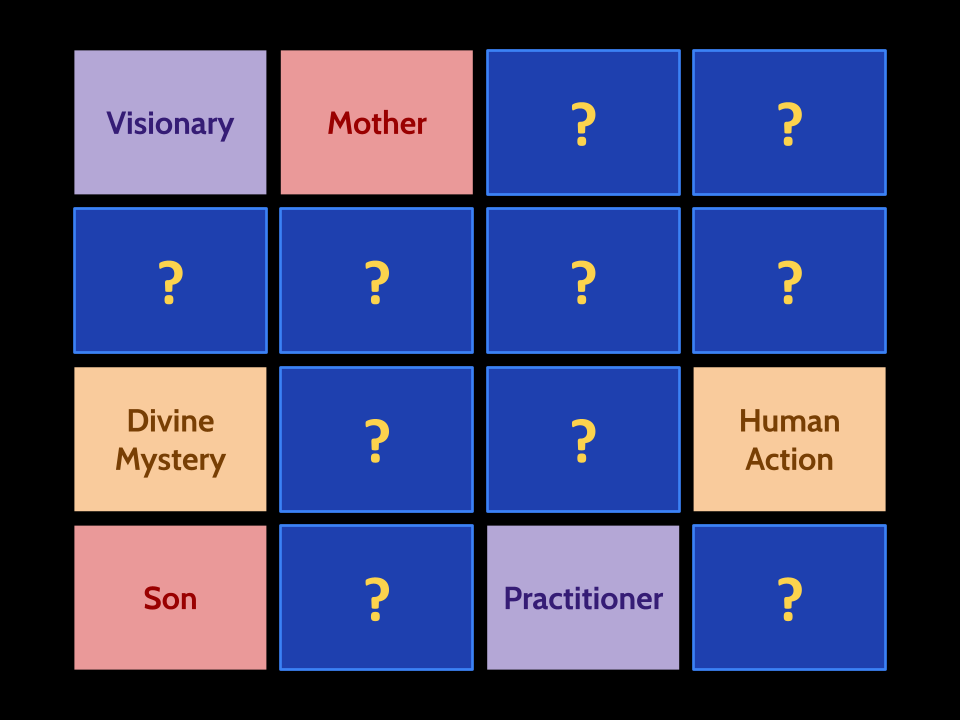
And then there is another interpersonal dynamic going on.
In both stories there’s a mother-son duo:
the widow with her small child
and Mary with her grown son Jesus.
We see both mothers involved in their children’s life:
Caring for them.
Feeding them.
Nurturing them.
Worrying about them.
Training them up.
The small child growing up among famine and drought
knows his mum will do all she can to keep him safe.
The grown-up child at the wedding party
knows his mum will do all she can to nudge him in the right direction.
There’s a sense of mutual care and affection between both mother-son pairs.
And reading on in scripture,
the future of both holds striking parallels:
There will be the untimely death of both sons.
Heartbroken mothers.
Yet also, two stories of hope,
even resurrection,
rejoicing.
But those are tales for a different day.
Well, actually, maybe not quite ….
Crisis & Celebration
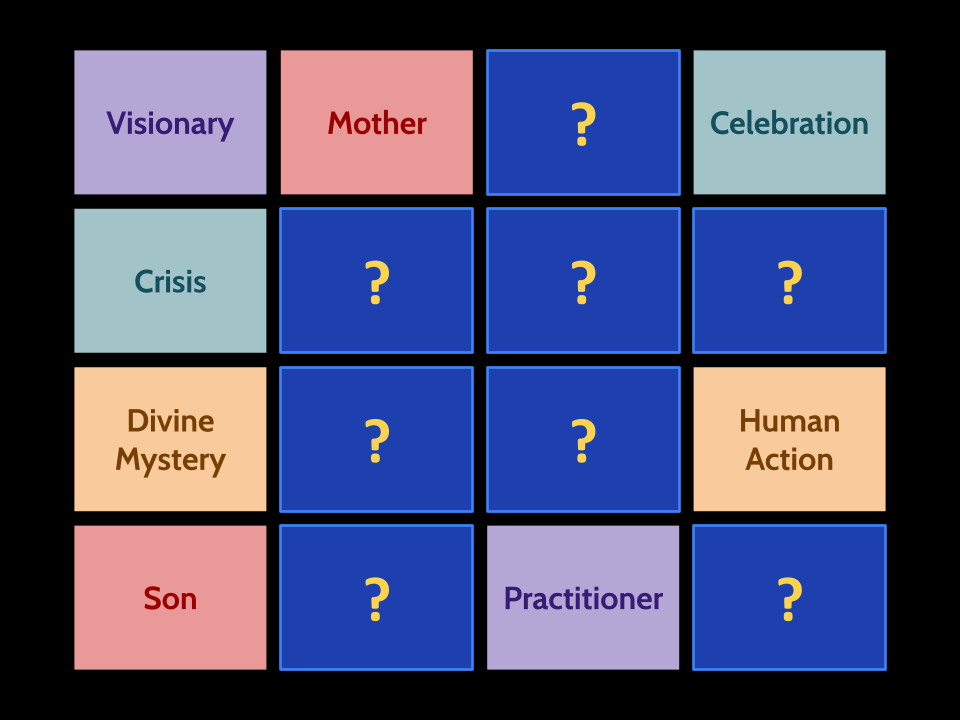
Because we find this heartbreak and rejoicing
foreshadowed
when we put these two stories side-by-side;
these stories of crisis and celebration.
The widow and her son are virtually at the brink of death.
It hasn’t rained in who-knows-how-long.
Drinking water is sparse.
How many of their neighbours have already buried a loved one?
Food is running out.
They are literally about to cook their very last meal.
On the contrary,
at the wedding feast there is food, music, and merriment.
New love is celebrated.
All neighbours from near and far are together,
laughing, eating, dancing.
Those moments in time couldn’t be much more different.
Yet both are valid.
Both are what life is made up of.
In both, human agency and divine presence are intertwined.
In time of need, bread is provided.
In time of celebration, the wine keeps on flowing.
Bread & wine

And, turning over or next two memory cards,
that is what we find.
Bread and wine:
one made by a mother,
the other made by a son.
One as a lifeline,
the other as an extravaganza.
Yet both sprung from people’s hard work and God’s miraculous workings.
Both symbols of a greater story.
Symbols of our story.
The story where humanity and the divine meet:
In signs of peace exchanged in holy chaos.
In words of ‘my body’ and ‘my blood’.
In bonds established and recalled around the Lord’s table,
throughout languages and nations,
past, present and future.
Bread & wine:
A lifeline.
And an extravaganza.
Enoughness & Abundance
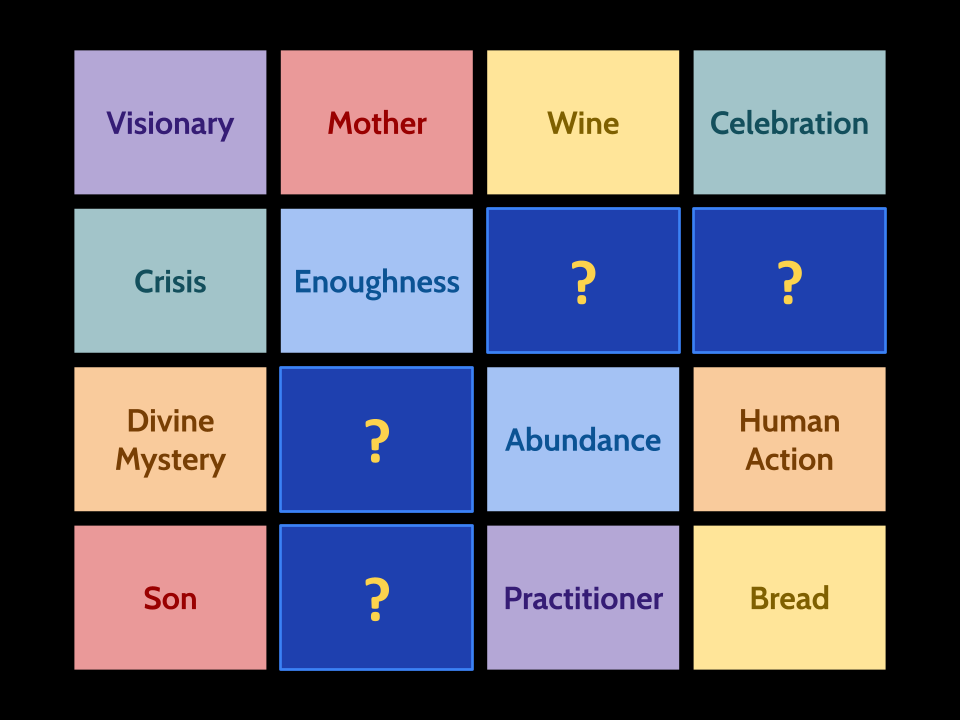
And that’s just what our next pair conveys:
enoughness and abundance,
necessity and indulgence,
bare minimum and plenty.
The widow, her son, and Elijah are getting by,
one day at a time.
They have just enough.
The wedding party can raise their cups
again and again and again.
What an abundance!
We shouldn’t take this contrast too lightly, though.
There are plenty of places right now
where ‘enoughness’ is lacking,
let alone ‘abundance’.
And there are places where
‘abundance’ is taken for granted
and ‘enoughness’ is frowned upon.
This world needs the beautiful interplay of human and divine action
to meet desperate needs,
and to lavish goodness far and wide.
Insider & Stranger
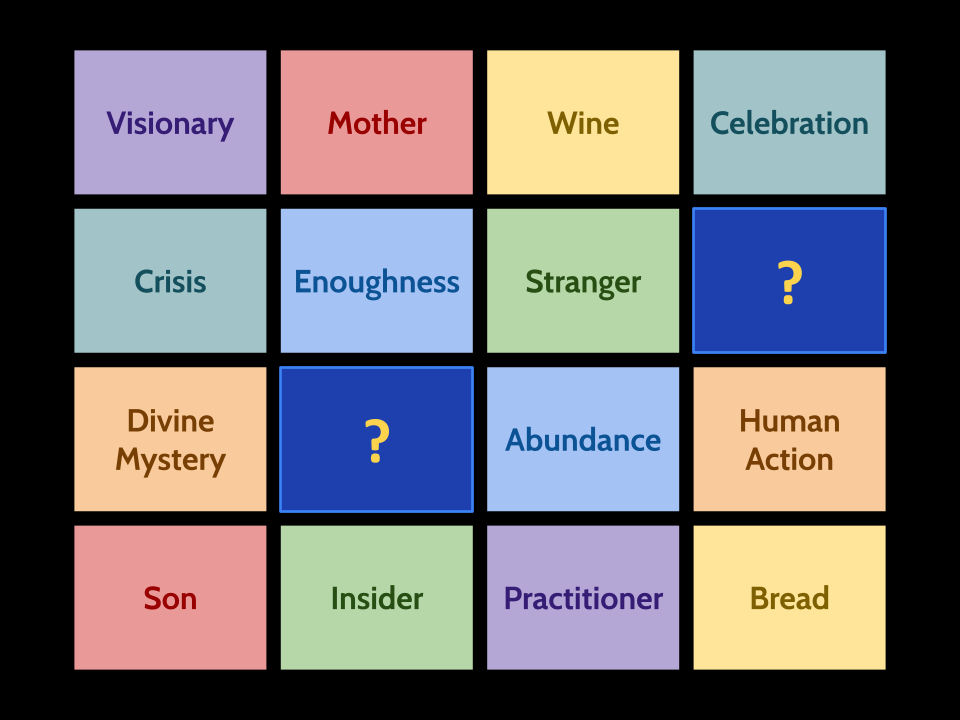
Far and wide, indeed!
Because our next pair says, ‘Insider’ and ‘Stranger’.
The Jesus story takes places at a wedding
within a tight-knit Jewish community.
There are relatives, friends, neighbours.
Everyone knows everyone
(including all their weird little ticks).
The Old Testament story, however,
talks about Elijah as, essentially, a refugee.
He crosses the border.
He is taken in by a generous soul
who neither knows him,
nor, realistically, has the means to care for him.
Again, it is for both people,
the insider and the stranger,
for whom busy hands and divine mystery work miracles.
And, yes, doing our part by
moving our hands in service
and folding in prayer is often hard:
Because relationships with ‘insiders’,
those closest to us
can be complicated, permissive, or controlling.
And because encounters with ‘strangers’,
those far away, and those different to us in all sorts of ways,
can be superficial, judgemental, or non-committal.
Yet, as divine and human life are beautifully interwoven,
so can the lives of apparent ‘insiders’ and ‘strangers’ become beautifully interwoven.
Intimacy & Community
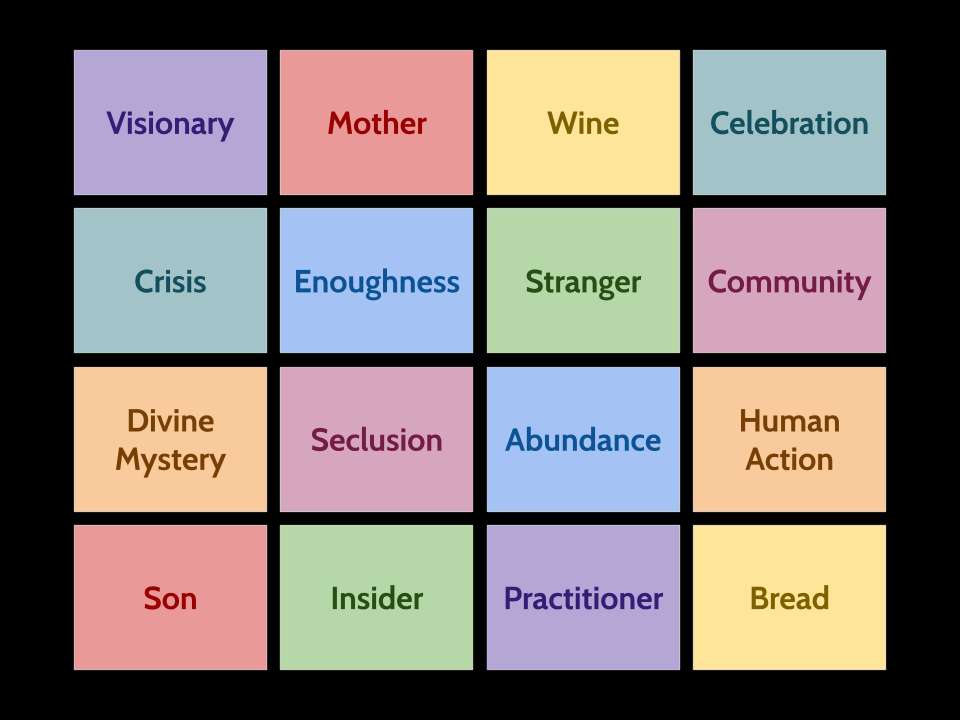
And this can happen, as our last pair reveals,
in different ways:
In the intimacy of a one-on-one encounter, as between Elijah and the widow.
Or in an extensive community, as at the wedding feast.
Neither is more or less valid or impactful than the other.
Intimacy and community are both needed:
with primary carers and wide support networks,
through private jokes and viral memes,
as shoulders to cry on and protesting crowds,
in private prayer and public worship.
Our love and God’s love builds and transforms
one-on-one relationships
and wide-spanning communities.
Conclusion
Well, what a ride!
Eight pairs on,
and your heads might very well be spinning.
Of course, you may have found more pairs in our two stories …
like the jugs of oil and water,
asking & receiving,
or prophet & Christ.
I invite you to keep on looking out for memory cards hidden throughout the week,
of connections you can spot
between our world and these stories,
between your ‘insider’ life and the lives of ‘strangers’,
between your actions and the divine mystery.
Or do take away with you one of those words up here on the screen,
the one phrase that resonated with you,
the one situation that touches you,
the one relationship that’s on your heart.
Let’s go out and notice that intertwining of human agency and God’s presence.
Let’s play our part in this beautiful interplay.
Let’s celebrate when human action and divine mystery interact with each other.
Amen.
Christine Ghinn
1st Feb 2026

 Freiburg Anglican Church