
A Friendly Guide to the Anglican Church’s Practices and Traditions
Curious about Anglican worship? From churchy words to robes, we’re exploring it all from A to Z over the next few weeks. This fun project, part of Christine’s ordination training, will unpack our quirky yet meaningful traditions. Stay tuned for weekly segments to learn and maybe laugh along the way!
A – B – C – D – E – F – G – H – I – J – K – L – M – N – O – P – Q – R – S – T – U – V – W – X – Z
An Introduction by Christine Ghinn
For the ‘Worship Module’ of my ongoing vicar training my assignment was to explore a worship aspect that is especially pertinent to my own church (Yes, you! The ACF!) Due to our multicultural and multi-denominational background I decided to focus on ‘Anglicanism in Worship’.
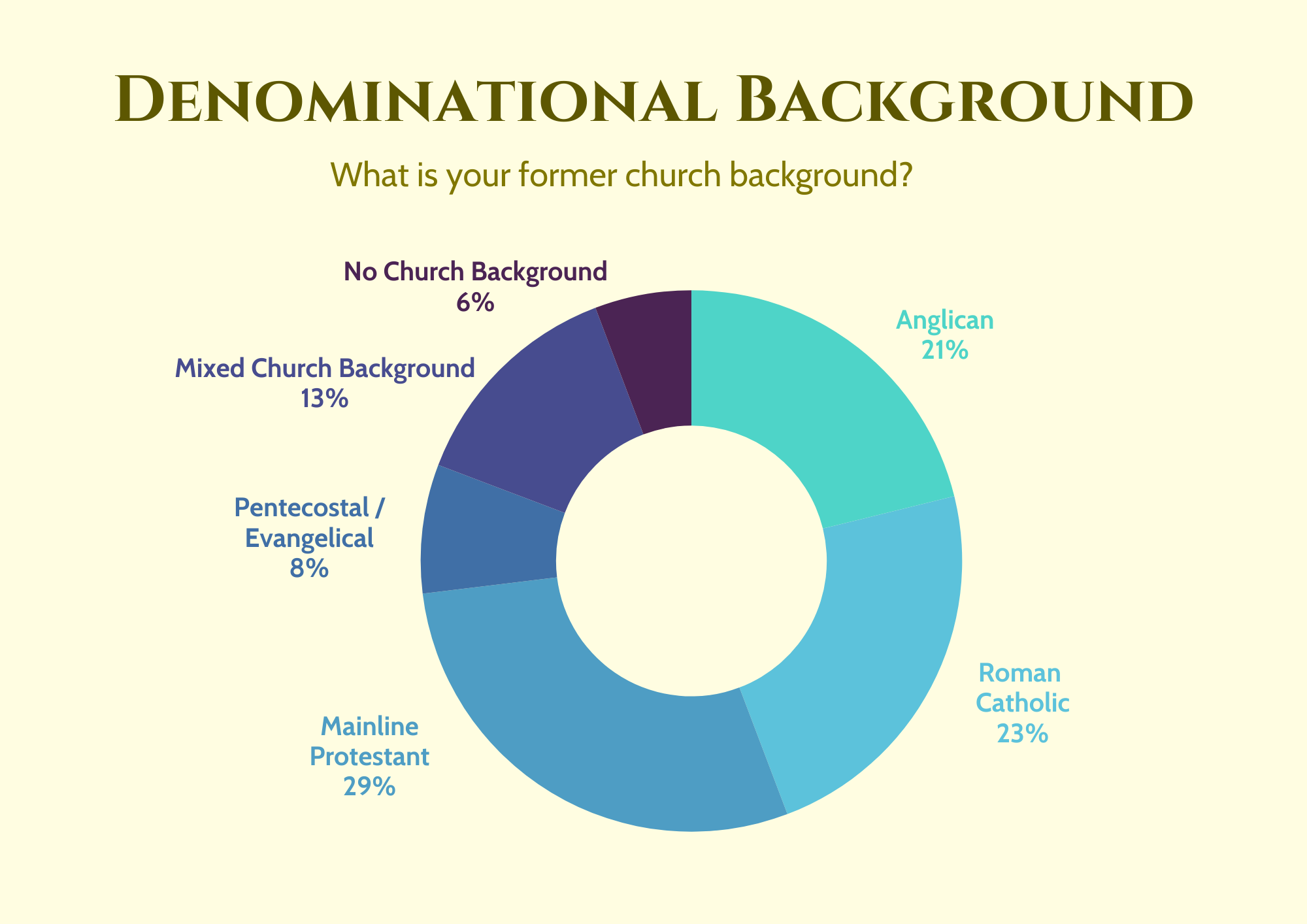
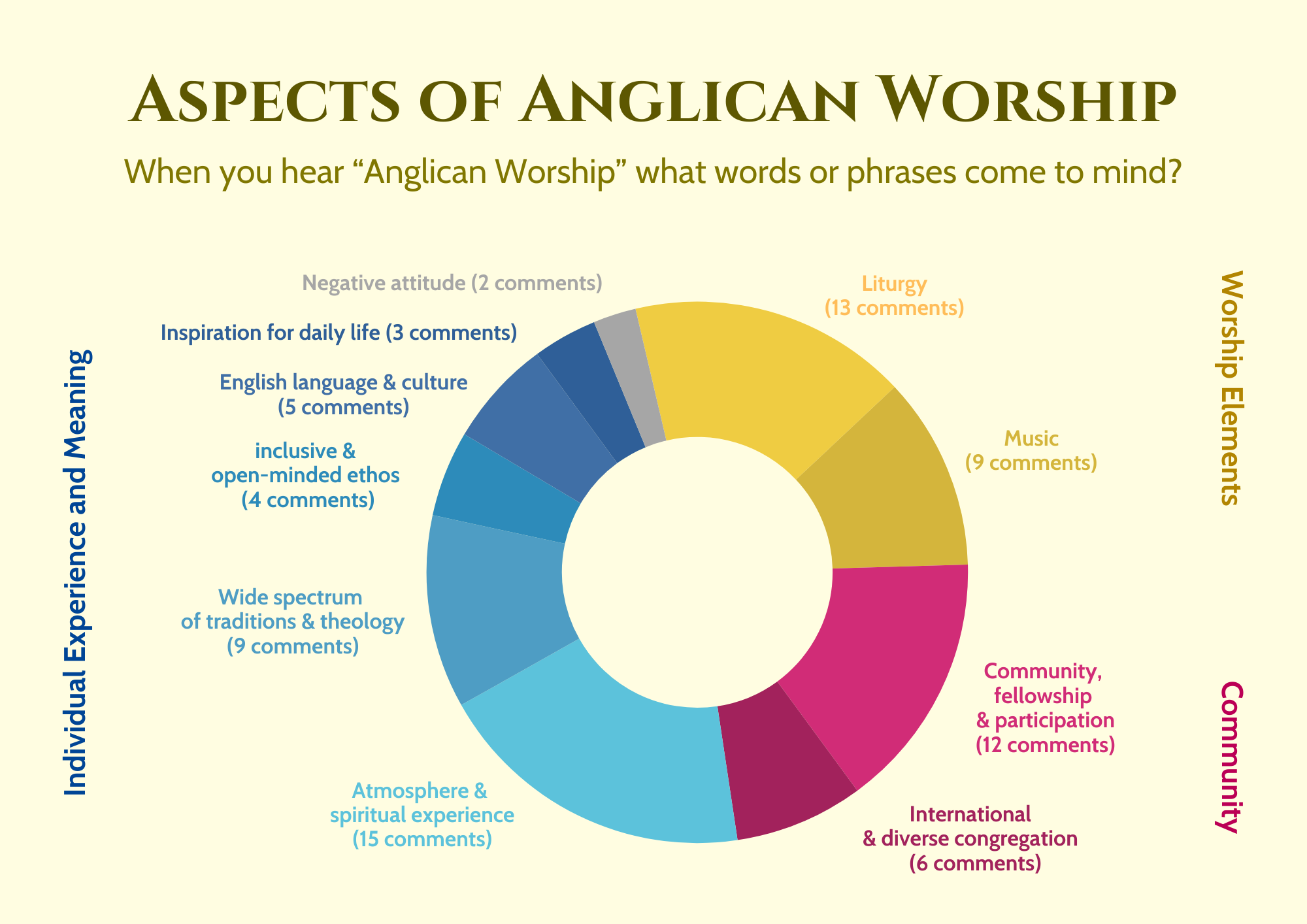
You may remember filling in a questionnaire on Easter Sunday, where I asked you to tell me something about your own church background, and about what you associate with ‘Anglicanism in Worship’. Thank you to all those many people who took part in this survey, which formed the basis of my written theological reflection.
Additionally to the written paper, I was asked to produce a related ‘real-life’ action item. As many of us (myself included) are not cradle Anglicans, I decided to put together an educational (and hopefully fun) series called ‘The A to Z of Anglican Worship: A Friendly Guide to the Anglican Church’s Practices and Traditions’. All 26 installments will be published – week by week – in the ACF Wednesday Email, shared on facebook, and added to a dedicated webpage. I hope you enjoy learning more about this weird and wonderful church tradition and I would love to hear any feedback or questions you may have!
What You Think: A Snapshot of Our Worship Community
Thank you to everyone who participated in the survey! Your insights provided a great snapshot of our chaplaincy’s rich diversity. I gathered 52 responses ranging from students to seniors, representing various continents, and church backgrounds. Many of you highlighted the sense of community, fellowship, and the inclusive spirit of our worship. Interestingly, 41% of you mentioned the diversity and expansiveness of Anglican worship, with some expressing joy over elements like the music and the welcoming atmosphere. Responses reflected a broad mix of church backgrounds, including Anglican, Protestant, Roman Catholic, Pentecostal, and more. Your honest feedback was incredibly valuable, not only for writing the assignment. Your thoughts reflect how we. the ACF, can celebrate our differences and embrace what makes our worship uniquely Anglican!


The A to Z of Anglican Worship
Anglican
In 1534 the English church broke away from the Roman Catholic church and became the Church of England (CofE). Over the centuries it kept on evolving, eventually comprising a vast variety of belief, tradition, and practice. Those churches around the globe which have originally emerged from the CofE are described as Anglican, and form together the Anglican Communion.
Anglicanism is diverse and hard to categorize – a church unlike any other! Here is room for uncertainties and even contradictions, for wonder as well as rationale. It’s a church that is hard to hold together and one that tries not to take itself too seriously.
Book of Common Prayer
This book of liturgies, abbreviated BCP, is the bedrock of Anglican worship tradition. Published in 1549 and revised in 1662, it was created by Archbishop Cranmer, and has since sustained the faith and daily prayer of many generations.
There are liturgies for services at different times of the day, week and year, as well as special occasions like weddings and baptisms. For many Anglicans, the BCP’s beautiful, poetic (and, as some may say, old-fashioned) prayers are to this day their most beloved way to worship, even though in recent decades the more modern Common Worship became the most widely used worship book for Anglicans.
Churchmanship
When Anglicans talk about ‘high’ or ‘low’ churches, they discuss churchmanship, meaning their very different approaches to worship and faith. On the ‘high’ end of the spectrum there are Anglo-Catholics, who value the rich liturgical heritage and elaborate rituals and symbols, like incense and classical sacred music. In contrast, ‘low’, evangelical churches tend to use as little liturgy as possible, often embrace contemporary music, and stress specific interpretations of the bible. ‘Broad’ churches are a mixed bunch somewhere in the middle.
As with all things Anglican, churchmanship labels are hard to attach: conservative and liberal beliefs are present everywhere on the continuum, as are both lively-charismatic and inflexible-ritualistic attitudes. This potpourri of Christianity is a result and illustration of the inclusive and accommodating Anglican ethos.
Doctrine
Anglicanism is generous in the beliefs—the doctrines—it holds and teaches. While individual lay and ordained Anglicans are free to cultivate and express their personal convictions on the Christian faith, the church as a whole is comfortable with a range of opinions and interpretations.
The Anglican intuitive response to the mystery of God is not to analyse or explain it, but to turn to awe and worship: “We pray what we believe.” Essentially, Anglican doctrine is expressed in the words of the prayers and liturgies, resting on the biblical texts. It affirms God as Father, Son and Holy Spirit, and is committed to the unity and inclusivity of the universal global church.
Eucharist
A central part of Anglican worship is the Eucharist (Greek for thank you), also called Holy Communion. The church community regularly gets together to share bread and wine, looking back to Jesus’ last meal before his crucifixion and forward to a final feast of peace and restoration.
To Anglicans, the Eucharist is more than a mere symbol. In it Christ is present and encounters people, regardless. It is to be experienced and trusted, not explained and theorised.
Fellowship
A beloved, and for some indeed essential, part of Anglican worship is the fellowship time after the service. The technicalities vary greatly: from weak, lukewarm tea to fancy barista coffee, and from dry biscuits to yummy cakes—or even bring-and-share lunches—nothing is impossible!
This is where introverts are teased out of their comfort zones, where the sermon is put under scrutiny, where news is exchanged, and where life is discussed. While this tradition causes controversies over coffee brands, plastic cups and volunteer rotas, it is ultimately a source of individuals forming community and God’s spirit moving through their encounters.
the Grace & Favourites like it
“May the grace of the Lord Jesus Christ, and the love of God, and the fellowship of the Holy Spirit be with you all.” (2 Cor 13:14)
This bible passage is one of the staples in Anglican communal prayer life. Many regular church goers know it by heart, and it is the go-to closing formula of small and large gatherings: from bible studies and council meetings to synods and church services.
The Grace is just one of many bible passages that repeats frequently in Anglican worship. For instance, words from Psalm 51:15 (“O Lord, open our lips, and our mouth shall proclaim your praise.”) start every Morning Prayer, the Sanctus (Is 6:3) proclaim God’s greatness at the Eucharist, and the Magnificat (Mary’s Song from Luke 1:46-55) is a fixed part of the Evening Prayer liturgy.
Traditional Anglican liturgy incorporates a wealth of bible passages, making them familiar and dear to worshippers, as expressed in the following little tale:
An Anglican lady was gifted a bible by her Baptist friend, who was worried about the former’s meager bible knowledge. Days later she excitedly thanked her for the wonderful present, which had “so many lovely quotes from the Prayer Book!”
Homilies & Sermons
Preaching is a key building block of Anglican worship and varies from five-minute homilies to 30-minute exegetical sermons. Here scripture, tradition and reason meet, the bible is brought into today’s context, and the Christian faith within life’s realities is nurtured: whether on Christmas Day, an ordinary Sunday during the year, a wedding service, or in light of a national tragedy.
It is not surprising then that many of the most esteemed Anglican theologians and writers were and are not full-time academics, but working parish priests, who, week in and week out, reflect on scripture’s view of the contemporary world, and vice-versa.
Intercessions
Anglican congregations respond to the bible readings and preaching by bringing their concerns about the world, the church and themselves before God. In the intercessions (also: Prayers of the People) and the Anglican litanies (set prayer series) worship and faith touch present-day realities and God’s love is spoken into all aspects of private and public life.
These prayers can look and sound very different. Sometimes there are set formulas of call and response, at other times a church member leads through specific prayers composed by him or herself, or creative, hands-on activities express the intercessions of young and old.
Jubilees, Coronations & more
The Church of England is the only Anglican church that is the established church within its territory. This means, among other things, that there are close links to the monarch and the government, and that the church has certain civic duties. This includes state weddings and funerals, remembrance services, and royal ceremonies like coronations and jubilee celebrations.
Unsurprisingly, there are voices from within and outside the church that call for a clear separation between church and state, just like it is elsewhere in the Anglican communion.
That being said, civic occasions are valuable moments to minister to the local community, the nation, and, as with broadcasted pompous royal events, the world. The CofE has the duty and privilege to accompany the citizens in joy and grief and in that way point to God’s love and presence within the big and small events of life.
Kneeling, Incense & other Quirks
Depending on the traditions of any Anglican church, a fair amount of movement and sensory impressions may be entailed in a worship service. Worshippers might get wet if the minister sprinkles the congregation with Holy Water to remind them of their baptism. Or incense may infuse the sanctuary (causing bliss for some, and cough fits for others).
Some express their devotion by held-up hands, the signing of the cross or kneeling; occasionally baffling their fellow-worshippers. Priests and other leaders follow different rituals during the services, from specific hand movements, facing eastwards, bowing and kneeling, to even washing their congregants feet at the Maundy Thursday service.
Here, too, the Anglican church does what it does best: providing an open space for a wide variety of faith expressions, and remaining together, despite the odd raised eyebrow.
Liturgy
Broadly speaking, Anglicans like traditions; they like things done properly. Many Anglican churches are liturgical, using prearranged prayers and texts to structure their worship services. According to its ancient Greek roots, liturgy is the “work for, or of, the people”. Liturgy makes all who are present partakers and co-creators of the service. It determines the flow of the various segments and constantly re-focuses the attention of the people towards the divine.
There are set liturgies for the Daily Offices (like Morning and Evening Prayer), Eucharist services, and occasions like weddings and baptisms. While certain portions are compulsory, there is much room for individuality and creativity.
Some of the main liturgical building blocks of an Anglican service include a Gathering (the opening), Penitence and Absolution (confessing where we wronged God or others), Collects (structured prayers for particular days, “collecting” the pleas of believers near and far), a Creed (affirmation of faith), Praise and Thanksgiving, the Peace, and a Blessing (sending out).
Music
To many, worshipping and singing are inseparable. Granted, there are some types of Anglican services, such as said Eucharists and some Daily Offices, that contain spoken words only, yet to most Anglicans that is the exception, rather than the rule.
Over the centuries Anglican composers, musicians and congregations have creatively shaped and employed a great variety of music in their service. These include the congregational singing of beloved classic hymns, psalm chants, choir anthems, and organ pieces, as well as all-age action songs, modern worship tunes performed by bands, and music based on the local heritage from all over the global Anglican Communion.
In a Western context, some of Anglicanism’s most renowned contribution to the Christian music scene are Choral Evensongs (a staple of most cathedrals that is currently regaining great popularity), the Service of Nine Lessons and Carols (traditionally happening on Christmas Eve, telling the story of humanity’s fall, God’s promises and Jesus’ coming through music and bible readings), and the compositions of contemporary worship leaders that are sung in many Christian churches globally.
In local churches music is, how could it be different, a regular cause for quarrels, but first and foremost an inclusive way of involving the gifts of young and old congregants and of lay and professional musicians. For some, music is their most cherished way of connecting to God.
Notices
Anglican’s weekly dose of communal bemusement and vital information are the announcements made at the end of a church service. This is where congregations are presented with desperate pleas regarding misplaced casserole dishes or gems like, “At the evening service tonight, the sermon topic will be ‘What is Hell?’ Come early and listen to our choir practice.”.
But then again, the notices are regular reminders that our worship is inseparably connected to our daily lives, and that a worshipping community of ordinary people is also connected through the weird and wonderful everyday encounters. God’s love is present in the church yard clear-up, as much as in the dedicated time of prayer inside the sanctuary.
Offering
There is this little story: A man was telling his friend about his very first visit to a church service. He said, “It was fantastic! Especially the part when they passed around a plate with cash. I took some too, and it paid for my Sunday lunch.”
The custom of giving money to the church during or after worship is customary in Anglicanism and most other Christian denominations and has its roots in the bible. In scripture there are accounts like Moses and Paul asking their people to donate from their possessions for the building and upkeep of their sanctuary, the ministry of their own religious community, or the mission of other churches.
This is what contemporary Christians are still doing when they place money in the offering basket, tap their card on a contactless giving device, or set up a standing order to their church’s bank account. Gratitude towards God, compassion for those in need, and the drive to make God’s love known to all is what inspires this generosity.
Peace
A classic feature of Anglican worship these days is the Sharing of the Peace, which spread from the Church of South India to Anglicans worldwide from the mid-20th century onwards.
During this ritual, the people are invited to exchange greetings, extending the peace of God to one another. In England the stereotype of awkward nodding at one’s neighbours and shaking of clam hands prevails in some places, whereas elsewhere in the Anglican Communion hugs, laughter and a tumultuous moving around erupts.
Quietude
In this noisy and busy 21st-century world, silence is a gift as much as it is a challenge. Anglican churches practise moments of quietude during worship to varying degrees, inviting congregants to not only stay physically silent, but to calm their minds and hearts. In this stillness they may sense the whisper of God’s Spirit, commit their burdens and worries into God’s caring hands, or contemplate the words they just heard or sung.
Silence can be kept at different places during the liturgy: after a bible reading or the sermon, during the intercessions or the confession, when the bread is broken at the Eucharist or in moments of remembrance.
Readings
As one Brazilian bishop used to joke, ‘The preacher might be terrible but since we have so many Bible readings, one way or another the congregation will get the message!’
The reading of bible passages is integral to Anglican worship. For Sundays and feast days the readings from the Old and New Testament, including allocated psalms, are assigned by the Revised Common Lectionary in a three-year cycle. What’s more, Anglicans that practise the Daily Office (Morning and Evening Prayer in either traditional or contemporary language) will have read or heard all of the Old Testament over a year, the New Testament every six months and the psalms on a monthly cycle.
Thomas Cranmer, the father of Anglican liturgy, believed in the transformative power of scripture in the lives of the people. This has been tried and tested over the centuries and is still true today.
Sacraments
For Anglicans, sacraments are those moments when God undeniably touches his people and their lives. They are “outward and visible signs of an inward and spiritual grace”. Sacraments symbolise and bring about God’s love for individuals and communities.
Commonly Anglicans uphold two sacraments; those which Jesus himself initiated: Baptism and the Eucharist. However, in the Anglo-Catholic tradition five more are included: penance, anointing of the sick, confirmation, marriage, and ordination.
The sacraments invite to revere and experience God’s love in a tangible way, even though they are by no means the only way to encounter Him.
Teamwork
The meaning of the word ‘liturgy’-work of the people-describes beautifully the nature of Anglican worship as being a great achievement of teamwork, and not merely the performance of an entertainer on stage.
The congregation’s responses, singing and actions make the service come to life. Ordained priests may preside over the Eucharist, authorised preachers give sermons, lay members prepare intercessions, assist as chalice bearers, or read out bible passages. There are musicians, sides people, and those who keep the sanctuary pristine and welcoming. Some plan the duty rotas, make coffee and tea, ring the bells, run children’s programs, or fulfil other various duties.
Customs vary from church to church and from country to country, but everywhere worship comes alive through the participation, the individual personalities, and the unique gifts of the people.
Unity
Anglicans firmly believe in unity, that bond which joins all those who love and follow Jesus. Reality, though, is often a different matter. Within Anglicanism, facets like shared liturgical resources and the Christian identity make for unity and continuation in worship. On the other hand, theological convictions vary greatly and at times threaten structural unity.
In relation to other Christian denominations the Anglican church has always held its door wide open and is longing for the unity of the one church of the first millennium, before it split into more and more branches. When Anglicans worship, they are both Catholic and Reformed: Catholic, because they see themselves in the unbroken legacy of the earliest church; Reformed, because they follow the Reformation’s recognition of the bible as the foundation of faith and worship.
Some Anglican provinces, such as the ones in India and Bangladesh, are a beacon of hope, as they already embody shared Christian life and worship with their ecumenical sisters and brothers, such as Presbyterians, Congregationalists, and Methodists.
Vestments
Malicious tongues claim that some Anglican priests are in their line of work only for the joy of ‘dressing up on Sunday’. Indeed, in many, especially Anglo-Catholic, churches worship leaders wear more or less elaborate special garments during services. This practice varies globally and locally and has undergone diverse changes since the 16th century.
While at some churches ministers will wear simple, everyday clothes in worship, elsewhere vestments like albs (long white gowns), stoles (coloured scarf-like material worn around the neck), or chasubles (poncho-type overgarments with intricate designs) are worn. The vestment colours change depending on the liturgical season and match the hangings and ornaments inside the church building.
There are strong views on vestments on both ends of the spectrum. Critics may perceive vestments as an expensive, outdated tradition that separates the clergy from the congregation and distracts from worship. Others cherish special garments for worship for their visual symbolism, dignity, and the way they connect with the biblical priesthood and the church’s history.
Worshippers
People worshipping in Anglican churches are a mixed bunch. Here, the doors are open to anyone, and-unlike in other Christian denominations-formal membership is fuzzy and only very loosely defined. Fervent traditionalists, doubters, and casual believers gather next to each other around God’s table, sing (more or less) harmoniously, and join in prayer.
The Anglican ethos is of a Christianity that is not taught but caught. It trusts that regular communal worship transforms lives. It believes that a local Christian community is not where people are obliged to attend, but a place they want to be because they are accepted and valued, as well as inspired by Jesus and his visions for a good life.
Xmas & Easter
For most Anglicans, as for other Christians, Christmas and Easter are the highlights of the church year. And yes, for the church Christmas and Easter are seasons, not just one-day events! Christmastide runs for 12 days from Christmas Eve (24th December) until Epiphany (6th January) and Eastertide for 60 days from Easter Sunday until the day before Pentecost.
Jesus’ birth is remembered at Christmas often with a late-night service on Christmas Eve and a Eucharist on Christmas Day. Other Christmas traditions include the Service of Nine Lessons and Carols (bible readings and Christmas hymns), the Christingle service (where the ‘Light of the World’ is symbolised by an orange with a candle and decoration), and nativity plays (the Christmas story acted out by children or other church members).
Easter celebrates Jesus’ rising from the dead and is one of the very earliest Christian traditions. Many churches hold Easter Vigils the night before Easter Sunday, and all worship on Easter Day with a particularly joyful Eucharist service.
Yearly Cycle
Beyond the two ‘biggies’ Christmas and Easter, Anglican Churches observe over the course of the year a cycle of seasons, feasts and celebrations, . This ‘liturgical calendar’ follows with its bible readings and prayers the life and ministry of Jesus and is a rich framework for worship, prayer, and spiritual growth.
The church year begins four Sundays before Christmas with the season of Advent, which focuses on preparing for the coming of Christ, before the celebrations of Christmastide. This is followed by a few weeks of ‘ordinary time’, leading up to the 40-day period before Easter, called Lent. This is a season for introspection and repentance, which some Christians use for fasting. During those weeks, worship expressions would be more understated, and churches may be less elaborately decorated. Lent ends with Passiontide, or Holy Week, where several special services commemorate the events leading up to and including Jesus’ death. His resurrection is then celebrated during Eastertide, concluded by Pentecost, when the coming of the Holy Spirit is remembered. The following almost 6 months are again ‘ordinary time’, including events like Trinity Sunday, Creationtide and Christ the King Sunday.
Throughout the liturgical year are saints’ days that connect Anglicans to the life and worship of the church’s past.
During the yearly cycle, different liturgical colours make an appearance: celebratory white at Christmas and Easter and the green of ‘ordinary time’ that points to God’s goodness for his creatures, and the Christians’ growth in faith. Red at Pentecost is the symbol for the richness of the Holy Spirit coming with fire onto Jesus’ followers, and the royal colour purple during Advent and Lent stands for Christ’s authority, as well as the church’s repentance.
Zoom & the digital world
In the 16th century the printing press revolutionized the world and the spread of information. For example, the printed Book of Common Prayer made worship accessible for ordinary people in all places at all times of the day. This transformed Anglican faith and worship just like the digital world is changing it in our generation.
These days, some churches stick to established procedures, while many replace their hymn books with screen projections and printed bulletins with email newsletters. Big, as well as small congregations record or broadcast their services or sermons. Worship leaders, preachers, as well as lay Christians profit from (or perhaps sometimes drown in) a wealth of worship, theology, and faith resources online, and the Church of England’s Daily Prayer app is making the century-old habit of daily worship appealing and practicable for a new generation.
Digital novelties are here to stay and are neither to be unduly adored, nor to be afraid of. The Church has experienced the joys and challenges of technical progress for centuries and knows: Digital tools can distract from worship or enrich it. They can divide people and build community. They sometimes spread complacency, but also make God’s love known in the world. At times their content is superficial, yet there are many offerings that can deepen our faith.

 Freiburg Anglican Church
You must be logged in to post a comment.